Paddle Georgia 2027
June 18-25, 2027
95 Miles, 7 Days, 1 Great Time!
Trip Summary
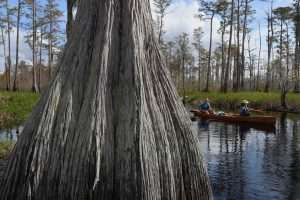 In celebration of the recent inclusion of the Okefenokee National Wildlife Refuge as a UNESCO World Heritage Site, Georgia Rivers will host Paddle Georgia 2027 on a course that begins in the heart of the Okefenokee Swamp and then charts a 95-mile course on the Suwannee River as it winds into Florida. After paddling the alligator-lined trails of the Okefenokee, participants will slip into the Suwannee where snow white sandbars, soaring limestone bluffs, springs and, surprisingly, a short run of Class II whitewater awaits adventurers. We’ll gather June 18 at Okefenokee State Park’s Suwannee River Eco Lodge in Fargo for our Kick Off Day Feast and Celebration. Paddling begins June 19 and continues through June 25 when we’ll finish the journey at Spirit of Suwannee Music Park, soaking in the afterglow of a successful journey with our River’s End Celebration that evening.
Registration
Participants can register to participate in all seven days or choose two, three and four-day options. Registration will open in early February. Offical Paddle Georgia 2027 registration fees will be posted at that time. Registration fees are expected to range from $70-$500, depending on the registration option you choose. Significant discounts are provided to families with two or more children. Scholarships for Georgia educators, women, people of color, recent immigrants, youth and low-income families and individuals are available.
Registration fees include tent campsites, shuttle services, overnight boat security, pit stops (strategically placed porta-toilets along our paddle routes), on-river and in-camp education programs, daily river maps and guides, Paddle Georgia 2027 t-shirt (or alternative swag), boat decal, and guide services. Registration fees do not include meal plans or boat rentals. Participants can choose from multiple meal plans or arrange their own meals. Meal plan costs for adults are expected to range from approximately $475 for a full seven-day meal plan to $130 for a breakfast-only, seven-day meal plan. Meal plan discounts are available for all children 12 and under. We encourage participants to take advantage of the catered meals as it simplifies logistics significantly.
Rental boats will be available from Paddle Georgia sponsors and vendors.
Got Questions? Click here for FAQs
Become a Paddle Georgia Sponsor
You can support clean rivers and the development of recreational water trails by sponsoring Georgia Rivers Paddle Georgia River Adventures. Depending on sponsorship levels, your tax deductible contribution includes complimentary registration(s) to participate in Paddle Georgia events. Click here to review a Paddle Georgia 2027 sponsorship packet or click here to make an online sponsorship donation.
Journey Details
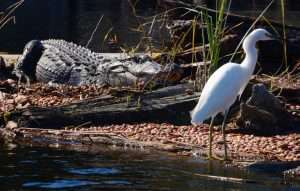 June 19 Okefenokee Swamp Stomp–Our journey kicks off with an 8-mile run through the west side of the Okefenokee Swamp. Alligators, turtles, and birds of all shapes and sizes line the paddle route that starts on the wide-open water of Billy’s Lake, winds tightly though the wooded Suwannee River “Narrows,” and then opens into a cypress-studed grassy prairie. From there, the course slips through the Suwannee River Sill and into the Suwannee River proper, where the paddle path is lined with Spanish-moss draped cypress and tupelo trees. The trip ends at Griffis Fish Camp, an old-school fish camp, legendary in Okefenokee lore.
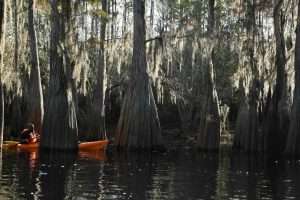 June 20 Fargo Flamenc0–This 14-mile run to Fargo is a visual feast. Unspoiled by river front development, the Suwannee’s blackwater reflects the stately trunks of soaring cypress trees as well as the tortured limbs and trunks of tupelo trees that resemble everything from dancing couples to Buddha bellies. Filtering the sunlight, Spanish moss accentuates every scene. Sandbars for lounging and play are frequent. The vibe is every bit as wild as the Okefenokee Swamp itself.
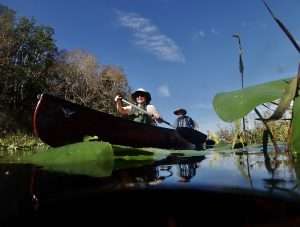 June 21 Boney Bluff Bump —Leaving behind the “metropolis” of Fargo, this short 10-mile jaunt flows deeper into the wilderness of the Suwannee River proper as the river flows between miles of unmolested bottomland forests and between a corridor of cypress and tupelo. Snow white sandbars are abundant as is the wildlife that call these woods home.
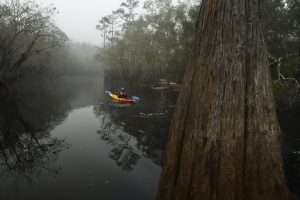 June 22 Borderline Boogie–On this 15-mile cruise, the Suwannee leaves Georgia and plunges into Florida. With signs of human habitation few and far between, you might find yourself humming the Florida state song…”Way down upon the Suwannee River.” The route is secluded and remote, with virtually the entire length of the route protected by Florida’s Suwannee River Water Management District. At the end of the day will move camp from Fargo to Spirit of Suwannee Music Park!
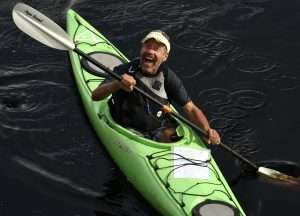 June 23 Bay Creek Ballet–The longest leg of the seven-day adventure, this 19-mile marathon winds by multiple conservation lands, keeping the scenery wild and the river remote. The shores of the Suwannee as it winds through Florida’s Northern Highlands are dominated by pines and hardwoods; the water is as black as it ever was, reflecting mirror images of the stately riverside foliage.
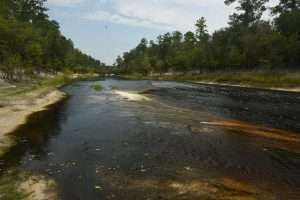 June 24 Big Shoals Shuffle–Believe it or not, there’s whitewater in Florida! This 14-mile run from Big Shoals to Blue Sink includes the run over Big Shoals where limestone ledges create Class II whitewater (don’t worry, non-whitewater paddlers can portage the shoals!). The route continues past Big Shoals to White Springs, site of one of Florida’s original tourist destinations, and Stephen Foster Folk Culture Center State Park, where you can visit a museum celebrating the folk music of Stephen Foster.
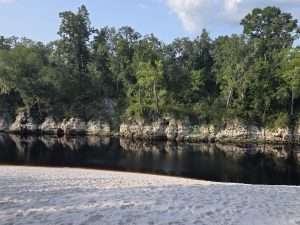 June 25 Spirit of Suwannee Slide–Our final 15-mile jaunt winds between snow white sandbars and soaring limestone bluffs with abundant play places and swimming holes and the chance to see a few of the Suwannee’s 196 freshwater springs. The paddle ends at the Spirit of Suwannee Music Park; stick around for a River’s End celebration suited for this epic cross-state-line journey!
Campsite Information
Okefenokee State Park and Suwannee River Eco Lodge June 18-22
Details Coming Soon!
Spirit of Suwannee Music Park June 22-25
Details Coming Soon!
Logistics--Getting There and Getting Back Home!
Details Coming Soon!
Meals
No one has ever gone hungry on Paddle Georgia! Each morning we begin our day with a catered hot breakfast typically featuring eggs, grits, breakfast meats, breads, cereals, yogurts, fresh fruit, juices and coffee with alternatives for vegetarians, vegans and gluten-free dieters.

Sack lunches with your choice of sandwiches come with chips, fresh fruit and dessert and are picked up at breakfast before boarding buses for the ride to the river. Vegetarian, vegan and gluten-free alternatives are also available. Sandwich choices will include a variety of specialty sandwiches each day such as veggie and hummus spinach wraps, chicken salad spinach wraps, tuna salad on wheat, Korean tofu and veggie garlic wraps, Cubano wraps with pork and Swiss cheese and more. Good ole peanut butter and jelly sandwiches will be available every day!
We end each day with a catered dinner ranging from barbecue to low country boils to taco and pasta bars. Again, vegetarian, vegan and gluten-free alternatives are available.
Our meals this year will be provided by Dry Your Eyes Catering in Conyers, regular caterers to Atlanta’s film and TV industry, including to the cast and crew of the Netflix hit Ozark!
We encourage all participants to purchase a meal plan. Our meal times are great opportunities to commune with your fellow paddlers, commiserate over the common struggle of the journey and spin tall tales…we never let the truth get in the way of a good river story! Let our caterers do the work while you enjoy the great times.
You will have access to your vehicles throughout the journey and grocery stores and restaurants are within a relatively short drive of each campsite. However, refrigeration is not available at our campsites for the masses and access to ice is limited.
Menus: Coming Soon!
Georgia Adopt-A-Stream
 Georgia Adopt-A-Stream instructors will offer chemical water quality monitoring workshops during this event. During the training, students learn chemical water monitoring protocols and collect and test samples for water quality. Following the training, participants can complete the Adopt-A-Stream certification process. By participating in this training, you’ll have the opportunity to assist in Georgia Adopt-A-Stream’s assessment of the health of the waterways we will paddle. When you return home, you’ll have a greater understanding of rivers and streams, and you’ll be certified to conduct routine water quality monitoring on a local waterway. You can sign up to participate during online registration or when you arrive at the event! Click here to learn more about Georgia’s Adopt-A-Stream program.
Daily Itinerary
Coming Soon!
Policies & Recommendations
Paddle Georgia Policies
- No alcoholic beverages are permitted on the river.
- All participants must attend the pre-launch safety briefing. Participants must adhere to the safety guidelines presented.
- Participants must wear a properly fitted U.S. Coast Guard approved personal floatation device at all times on the river.
- Participants under age 18 are the responsibility of, and must be accompanied by, a parent or guardian.
- Sorry, no pets allowed.
- All participants must sign a Medical and Emergency Contact Information sheet and a Waiver of Claims and Release of Liability form. Parents must sign for children under the age of 18. (These forms will be sent in the information packet.
- Person-powered watercraft only.
- All participants must respect private property along the river.
- All participants must possess basic paddling skills and be capable of self-rescue in the water.
- No more than 2 children under the age of 12 per adult guardian.
- All children must have a designated seat in the vessel in which they are traveling. (no children on decks of kayaks or as “passengers” in cockpits of solo kayaks)
- Georgia Rivers is not responsible for any personal property that may be lost, damaged, or stolen during the trip.
- Paddle Georgia is a non-partisan, apolitical event that welcomes people of all political persuasions, races, religions, sexual orientation and ethnic backgrounds.
- As a 501c3 organization, Georgia Rivers is prohibited from endorsing specific candidates or political parties. Therefore, participants are prohibited from exhibiting signs, banners, flags or other campaign materials endorsing specific candidates for office within Paddle Georgia campsites. We also encourage particpants to refrain from wearing clothing that could be construed as divisive, offensive to others or may be inappropriate for our family-friendly event.
Code of Conduct
At Georgia Rivers, we like to think of our river adventure participants as our “river family.” We come from many different backgrounds, but the river is the great equalizer and our common bond. We want all participants to treat one another as family.
Dos…
- Be respectful of all participants, including their property, their person and their personal views. On our river adventures you will paddle, eat and camp with people that are very different from you. Please respect and celebrate those differences.
- Be helpful. If you see someone that needs a hand in camp or on the river, please lend yours.
- Be courteous. Be prepared to wait in lines for restrooms, shuttle buses, meals and more. Remember, we are all in the same boat; only by working together can we get everyone safely down the river.
Don’ts
- Use inappropriate language. This is a family event with participants of all ages.
- Verbally or physically intimidate or abuse other participants.
- Become intoxicated or under the influence of mind-altering drugs.
- Violate quiet hours by engaging in loud talk and disruptive behavior between 10 p.m. and 6:30 a.m.
Violations of these policies and our code of conduct can result in the participant being removed from the event without refund.
For Parents and Guardians of Children
Parents and guardians are responsible for the welfare and safety of their minor participants at all times, both on the river and in camp. Understand that while Georgia Rivers’ river adventure trips almost without exception attract uncommonly good and kind people, Georgia River Network does not screen participants or conduct background checks on participants.
Recommended Items to Bring
What Should I Bring? (here’s a checklist of essential items!) First Aid Kit; Sunscreen; Necessary Medication; Water Bottles (at least 3 quart bottles for each person); At least two paddles for each boat; Flexible mindset; Tent or other shelter, sleeping bag or sleep sack and sleeping pad (if you are camping); proper footwear for river and land; rain gear; whistle for signaling emergency.
Here’s a checklist of suggested optional items: Labels with your name for your boat, luggage, and other personal belongings; Ground Cloth; Reusable Plate/Utensils (wash stations provided); Clothing for weekend; Waterproof Stuff Sacks for Camp Gear; Waterproof stuff sack or case for lunch and other on river items (like dry clothing); Clothes/Swimsuit; Money to tip the caterers; Insect Repellent; Towel/Wash Cloth; Soap, Toothpaste, Toiletries; Flashlight/Head Lamp; Book; Camera; Watertight cases for Boat; Fishing Gear/License; Duct Tape; Sponge; Bailer; Snacks for river and camp; Hat or Cap (don’t forget to get your Paddle Georgia hats!); Bug netting; Extra Length of Rope; Ear Plugs (Some of our paddlers snore!); Sleep Shades (Lights out at 10 p.m.); Laptop & Electronic Communication Devices (optional); Water Guns/Cannon (optional and encouraged!); Lightweight long sleeved pants or shirts for bug protection in the evening; Layered non-cotton clothing.
16 Things You Should Bring on the Water Each Day
- At least two paddles for each boat.
- PFD—every Paddle Georgia participant must wear a Coast Guard approved personal flotation device at all times while on the river (no ifs, ands, buts or “gee, it’s really hot!” – this policy is STRICTLY enforced)
- Every canoe should have two lines, a bow line and a stern line 8-10 feet each in length secured in such a way that they are readily accessible, but cannot come loose accidentally. Loose rope increases the risk of entanglement in the event of capsize. Kayaks should have grab loops at both bow and stern.
- An extra throw rope in case of emergencies should be stored safely in each boat.
- Attach a whistle to your life vest or body to signal for help in case of emergency.
- A Knife
- Waterproof matches or other fire source in waterproof covering.
- First Aid Kit—while boats will be on the river with basic first aid supplies, each vessel should bring a first aid kit stored inside a waterproof bag or container.
- A repair kit—each vessel should be able to make their own repairs (duct tape, sealant, waterproof tape and other materials are recommended)
- Rain Gear—Be prepared to get wet and potentially cold. Every participant should have access to a lightweight rain jacket and rain pants in a waterproof bag or container.
- Change of Clothes—Be prepared to take an unexpected swim. Every participant should have access to a dry change of clothes kept in a waterproof bag or container.
- Appropriate footwear that will protect your feet from unseen underwater hazards and permit you to walk comfortably on land when launching and taking out and in the event that you must exit the Paddle Georgia course.
- Sunscreen—Sunburn might be the trip’s biggest hazard.
- Water Bottle or Three —At least three quarts per person per day is recommended. Bring sufficient water for the day’s paddle for everyone in your boat. Also consider bringing electrolyte packs or powdered sports drink mix to add to your water to avoid dehydration. Drinking water is not available along the Paddle Georgia route and no drink is provided w/ sack lunches. Many paddlers will fill one bottle with water and another with sports drinks (provided each morning for you to fill your own bottles).
- Food—There is no access to food along the Paddle Georgia route. Sack lunches are provided to participants. No drink is included with the lunch.
- Dry Bag or Ziploc—Bring a waterproof bag to protect items you don’t want to get wet, including your lunch.
Safety Procedures
Paddle Georgia participants should be aware that this canoe trip is not a commercially-guided trip. While Georgia Rivers and Paddle Georgia staff will be available on the river during each day’s paddle and participants with medical and/or First Aid training will be identified, we cannot personally ensure the safety of all participants. Unlike a commercial trip in which paid guides direct you through each bend of the river, Paddle Georgia is designed to be your adventure, and as such, you are responsible for your own safety. All participants are assuming risks (some of which are outlined below) while participating in Paddle Georgia.
Skill Level Required: Paddle Georgia is suitable for novices and beginners. Paddlers should have a basic understanding of paddle strokes, should be able to control their vessels in moving water and be capable of self-rescue in moving or deep water. If you are new to paddling, we highly recommend that you take a canoe/kayak paddling course prior to the trip. Our route is all flat water; there are no shoals or rapids. Georgia Rivers offers regular kayaking skills classes. If you are new to paddling, this course will give you the knowledge and skills you need to begin safely exploring Georgia’s rivers.
For a reminder of basic paddling safety practices, watch this American Canoe Association Video.
Weather: Average High Temperature: 91 F; Average Low Temperature: 70 F. Average June Rainfall: 6.8 inches, with afternoon showers and thundershowers common.
Hazards:
Strainers—Strainers are branches, trees, vegetation or other partially or totally submerged obstacles in the river’s current often found along the river’s edge. These hazards allow only water to pass through freely. The current will pull anything else down, plastering it into place, similar to the action of a kitchen colander. It is best to approach submerged trees or logs along the river bank from the downstream side to avoid having the current pin your boat against the obstacle or flipped by the force of the water. You should also avoid grabbing on to low hanging branches of partially submerged vegetation as this action can often cause your boat to capsize. To avoid a multi-boat pile up, leave enough room between boats to allow each boat to safely navigate around these obstacles.
 Weather—Strong thunderstorms and high winds are not uncommon. In the event of inclement weather that includes the risk of lightning, paddle to shore, secure your boat and find cover under a dense stand of small trees. Avoid open areas, especially open areas with solitary trees, and avoid gathering in large groups. By dispersing yourselves over a large area, you reduce the risk of lightning striking numerous individuals at one time. Squatting, with your feet on a personal flotation device or seat cushion, is a good idea when in the midst of a thunderstorm (while on solid ground—not in your boat!).
Sun and Heat—Hats and appropriate sun screen are recommended. If you get too hot, the river comes with built in air conditioning – get in and cool off. You should carry at least three quarts of water each day to avoid dehydration. Sports drinks with electrolytes are also recommended. The first two days are usually the most difficult as we acclimate from spending lots of time in air-conditioned buildings to spending all day in 80-90-degree heat. Prepare by drinking lots of fluids in the days leading up to the trip.
Water Temperature—The combination of cold water and a cold afternoon thunderstorm raises the risk of dangerous changes in body temperature. Be prepared with rain gear and layered clothing that stays warm even when wet (avoid cotton).
Water Quality – Due to a variety of conditions, water quality can vary and organisms that cause illness may be present. Swimming and submersion in the water increase the risk of contracting water-borne illnesses. Ingesting river water should be avoided and cuts and sores should be kept out of the water and treated if exposed.
Trash—Unfortunately, Georgia’s waterways collect refuse from surrounding communities. Proper footwear and exercising caution can prevent unnecessary injuries. Participants should wear sandals or shoes that provide adequate protection from broken bottles, rusted appliance parts and tin cans and anything else you might find at your local landfill.
Venomous Snakes—The land surrounding our paddle routes is potential habitat for two venomous snakes—rattlesnakes and copperheads. If you encounter any snakes, simply leave them alone. Should you have the misfortune of being bitten, remain calm and get medical assistance as quickly as possible. Bites from these venomous snakes are rarely fatal, given proper medical attention. At any given moment on this trip you will not be more than a few hours from a hospital.
Terra Firma—Please step carefully when paying visits to land, especially when carrying your boat over uneven terrain.
Your Fellow Paddlers—This is a journey involving many individuals with varying degrees of skill level. Space yourselves so that you do not interfere with one another when maneuvering around obstacles. Pileups on the river can be just as dangerous as those that occur on interstate highways.
Paddle Georgia “Buddy System”
We will rely on the “Buddy System” to ensure that all participants arrive safely at the day’s take-out point. Before each day’s paddle, identify your “buddy boat or boats.” This will be the boat or group of boats with whom you will paddle for the day. The group is responsible for ensuring that if someone needs help on the river that someone is nearby to provide help and that no one is left behind. Do not lose sight of your buddy boat or members of your buddy boat group. Participants who have not identified a buddy boat for the day’s paddle will not be permitted to launch from the day’s put-in point. A sweep boat will bring up the rear of the day’s paddle to further ensure that no one is left behind
Other Considerations
What do I do if I capsize? On slow moving water, stay with your boat and swim it to shore or shallow water where you can dump the water and right your vessel. It floats even when full with water and can support you if you become tired. Make sure your belongings are secured to your boat to keep from losing them in the event of a capsize. Your fellow buddy boaters can assist in recovering any belongings and help you right your boat.In fast-moving water or rapids, get away and upstream from your boat until you reach slower moving water. Float on your back, feet downstream. Don’t try to stand in fast-moving water. Rocks or other objects can trap your feet and the force of the water can hold you under. Moving canoes filled with water can pin or crush paddlers against rocks or trees.
In the event of inclement weather…As noted above, thunderstorms are not uncommon, however, usually these afternoon-variety showers do not last long. If you are on the river during a storm event, take appropriate cover as described above, wait out the storm and continue your journey when it appears safe. Protective facilities along the river for large groups are not available.
We will make every effort to ensure that each day’s paddle is completed in full. However, if all-day dangerous weather is predicted, Spring on the Satilla will be cancelled for the day. Boats will be shuttled to the day’s next put-in point. Rain alone does not constitute dangerous weather. All participants are expected to paddle rain or shine, or they may make their own arrangements for moving themselves and their boats to the next put-in and campsite. Exceptions may be made for families paddling with small children.
Swimming…Swimming is permitted with PFDs, but of course, swim at your own risk. Water quality on this journey varies due to point and non-point source pollution. Water quality is generally at its least healthy immediately following rain events—this is especially true downstream of urban areas.
Private Property…As you will see, our route on the St. Marys takes you through many a neighbor’s backyard. Private property must be respected. It is illegal to trespass onto someone’s property, and it is an offense that is prosecutable by law. You may not enter someone’s property unless you have first received permission. At least one rest stop, with portable toilet facilities and/or restrooms will be available at the approximate midway point of each day’s paddle, therefore it is imperative that you make use of bathroom facilities when they are available. If nature calls, please use a camp trowel and cover all human waste appropriately or carry a sealable plastic bag to remove your waste with you.
Communication in the Event of Emergency…There will be cellular phones on the river at all times (one with the lead boat, one with the sweep boat and others in between). In the event of an emergency, attempt to signal or locate a boat with a cellular phone. If cellular service is available, the participants in these boats can communicate with land-based emergency personnel and on-the-water motorized boats where available.
Universal River Signals…Participants are expected to use universal river signals to communicate with other boats. They are as follows:
- Stop: Potential Danger Ahead—Form a horizontal bar with your paddle and outstretched arms above your head. Those seeing this signal should pass it back to others in the party. Participants should wait for the “all clear signal” before proceeding.
- All Clear—Form a vertical bar with your paddle, raising your arm and paddle above your head. The paddle blade should be turned flat for maximum visibility. This means the trip can proceed. To signal direction or preferred course through an obstacle, lower the all clear to a 45 degree angle toward the side of the river with the preferred route.
- Help/Emergency—Wave paddle over your head and give three long blasts on your whistle. Whistles are best carried attached to your life vest. This means other paddlers should assist the signaler as quickly as possible.
- I’m OK—Holding your elbow out to the side, repeatedly pat the top of your head with your hand. This signals that you are not hurt and do not need assistance.
Georgia Educators Scholarship Program
Are you a Georgia K-12 educator and looking for an incredible summer adventure? Apply to receive a full scholarship to participate in Paddle Georgia 2027 and receive environmental education curriculum and Georgia Adopt-A-Stream training during the seven-day journey. You’ll have the trip of a lifetime and learn curriculum and skills that can help connect your students with Georgia’s rivers and streams! The scholarship pays your full registration fee. The scholarship program is open to all Georgia teachers working in K-12 public or private schools. The application deadline is March 30, 2027; scholarship winners will be announced in early April. SCHOLARSHIP APPLICATION COMING SOON!
Official Coffee of Paddle Georgia--Cafe Campesino
 Our friends at Cafe Campesino will provide coffee to fuel each day’s paddle! Endless morning cups can be purchased on site with a portion of proceeds donated to Georgia Rivers. Iced coffees and other treats will be available for purchase in the afternoon.
You can also enjoy Cafe Campesino coffee year-round! Purchase the Georgia Rivers Blend Viennese Roast Coffee on the Cafe Campesino store by clicking here.
A portion of online sales are also donated to Georgia Rivers.
Paddle Georgia 2027
a project of
Georgia Rivers


126 South Milledge Avenue, Suite E3, Athens, Georgia 30605 | (706) 549-4508 (phone) | info@garivers.org