
PRESS RELEASE
Recreational Boating Debate Heard in Senate Committee for SB 511
February 19, 2026
After hearing more than an hour of debate over a bill aimed at supporting river tourism and outdoor recreation today, a Georgia Senate committee opted to seek more information about the history of laws determining where Georgians can legally boat down the state’s smaller streams.
Atlanta, GA, February 19, 2026 – After hearing more than an hour of debate over a bill aimed at supporting river tourism and outdoor recreation today, a Georgia Senate committee opted to seek more information about the history of laws determining where Georgians can legally boat down the state’s smaller streams.
The Senate Transportation Committee did not vote on SB 511, the Georgia River Heritage Act. Instead, Chairman Greg Dolezal (R-Cumming) directed committee staff to seek a legal opinion from the Senate’s legislative counsel answering the question: Are there streams in Georgia that are privately-owned—known as “non-navigable streams”—where the public has the right to use the streams for recreational boating?
SB 511, introduced by Sen. Shawn Still (R-Suwannee), seeks to affirm what outdoor recreation advocates say is a longstanding tradition in Georgia—the public’s right to boat down small streams and rivers capable of supporting passage in recreational boats like canoes and kayaks.
The bill states that Georgia citizens have an “inherent right to use non-navigable streams solely for the purpose of passage.”
If adopted it would protect river tourism, small outfitter businesses and fishing guides operating on small streams like South Chickamauga Creek in Catoosa County, the Chattahoochee River in White and Habersham counties, Big Cedar Creek in Floyd County, Ebenezer Creek in Effingham County and the Cartecay River in Gilmer County, among many others.
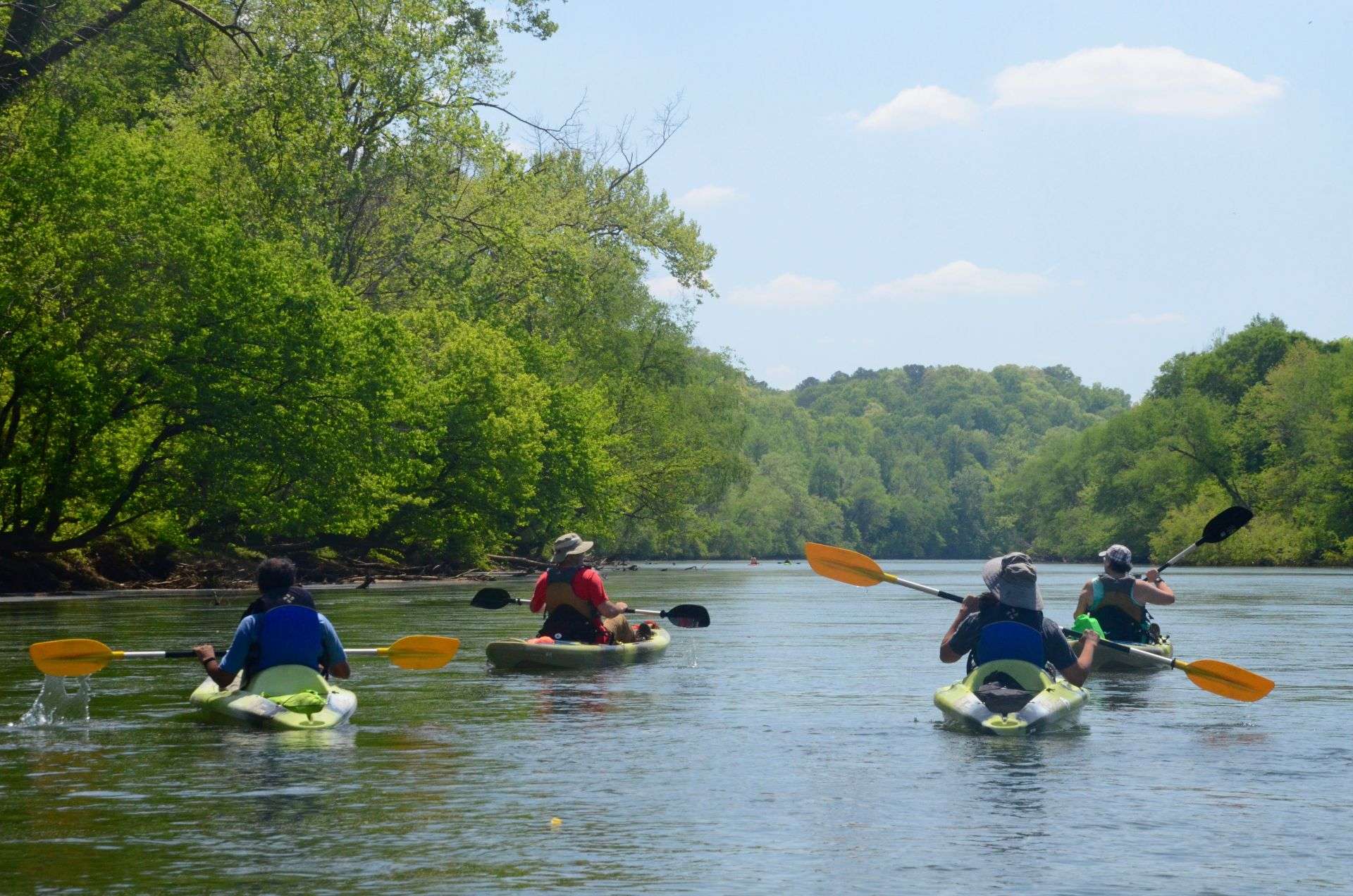
Supporting the bill were representatives from Georgia Rivers, the Georgia Association of Convention & Visitors Bureaus and local outfitters who urged the committee to adopt the bill to support the state’s tourism economy and keep Georgia competitive with neighboring states that already protect recreational boating on small streams.
Opposing the bill were representatives from the Georgia Farm Bureau and Georgia Agribusiness Council who argued that allowing boaters to float down small streams would violate private property rights.
Georgia Rivers Executive Director Rena Peck read a statement from Clay Courts, an owner of the Nantahala Outdoor Center which operates on multiple streams in Georgia:
“Our business model depends upon boating passage down small rivers…This bill provides certainty for our operations by affirming the right to pass down small non-navigable streams that are capable of supporting recreational watercraft. It also supports outdoor recreation tourism and related jobs in Georgia while putting Georgia on a level playing field with neighboring states where such policies are already in place.”
Florida, South Carolina, North Carolina and Tennessee all have policies that permit canoes and kayaks to float down any stream that is capable of floating such watercraft.
Peck pointed to a Florida canoe and kayak club that has told her organization that they do not travel to Georgia as often because of fear of being harassed or arrested for floating down the wrong stream.
Both the bill’s supporters and detractors pointed to an 1849 Georgia Supreme Court decision as evidence to support their arguments.
In that case, decided at a time when rivers were critical to commerce and the state’s economy as a means of moving goods to and from markets, the court determined that there were two kinds of inland waterways: ones that are wholly private (not capable of supporting boating) and ones that are privately-owned but that support boating passage. On that second category of streams, the court held that a public easement exists that allows the public to boat down these streams.
Referencing this decision, Adam Bellflower with the Georgia Farm Bureau noted that Georgia code adopted in 1863 created two distinct kinds of inland streams—navigable and non-navigable—and that on non-navigable streams property owners have the right to exclude the public, “We see this bill as a direct infringement on the rights of non-navigable landowners. If you allow passage [on a non-navigable stream], you are taking away a right from a landowner.”
Joe Cook with Georgia Rivers countered that the 1849 Supreme Court decision still protects passage down non-navigable streams and that adoption of the bill would protect outfitters and guides that operate on these small rivers: “You have the opportunity in this bill to clarify that public easement to support the commerce that is now taking place on our inland rivers.”
Chairman Dolezal questioned whether Georgia law supported the idea that a category of non-navigable streams exists upon which the public has a right to pass down in recreational boats. “That’s what we need clarity on.”
“The hearing provided an important opportunity for dialogue on this issue,” Peck said. “We need to find ways to balance the competing interests of property owners, outfitters and recreational boaters or we run the risk of streams being closed to the public. Such outcomes would be bad for Georgians and our state’s robust tourism and outdoor recreation economies.”
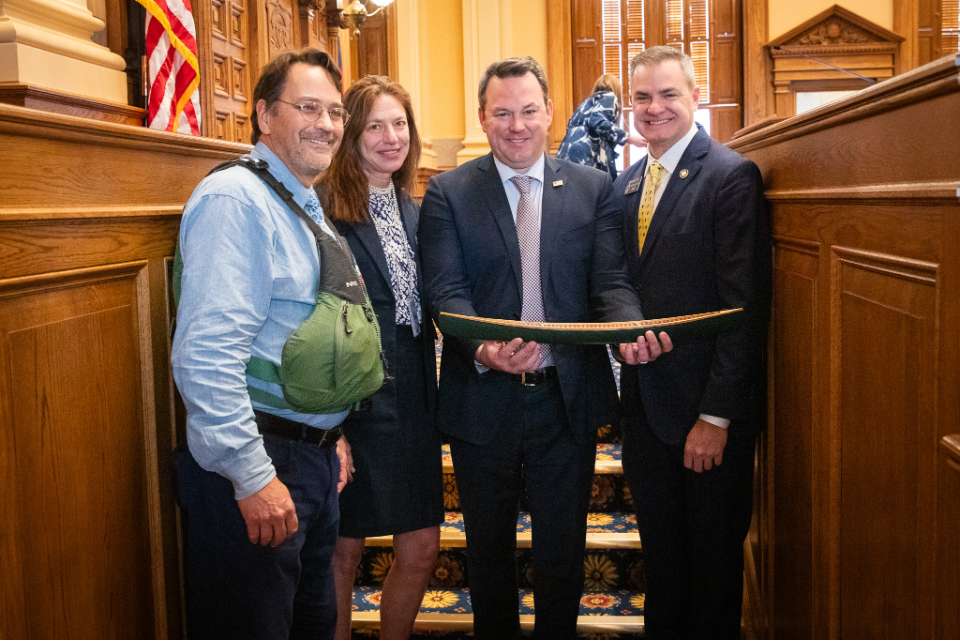
Pictured left to right: Joe Cook (Paddle Georgia Coordinator), Rena Ann Peck (Georgia Rivers Executive Director), Lt. Governor Burt Jones, Senator Shawn Still
###
For More Information:
info@garivers.org
About Georgia Rivers:
Georgia Rivers is a statewide 501c3 organization with the mission to protect and connect people with Georgia rivers. Georgia Rivers serves as Georgia DNR’s non-profit partner running the Georgia Water Trails Network, creating river maps and guides and providing the free Georgia River Guide mobile app. Georgia Rivers connects people to Georgia rivers by hosting paddle trips across the state, including the signature week-long Paddle Georgia camping adventure hosted on a different Georgia river each year; and by conducting kayak training and safety classes. Georgia Rivers also serves as fiscal sponsor of the Okefenokee Protection Alliance, Georgia Outdoor Recreation Coalition and Georgia Water Coalition.
Visit garivers.org to learn more about paddle trips, water trails and ways you can protect Georgia rivers.